![[Moon Phases]](../moonphases/2025-08-phases.jpg) |
|---|
 |
 |

 AUGUST 3, 2025: Perseids Under Moonlight
![[Perseid Radiant]](8-25-perseids.png) |
|---|
| Observe Perseid meteors after midnight when rates increase. Light from a waning gibbous moon (upper right) will dampen rates, but not the bright meteors and fireballs that often accompany the time around maximum activity. This map is set for 4 a.m., August 12. Gary A. Becker graphics using Software Bisque's The Sky. |
AUGUST 10, 2025: Sagittarius and Scorpius at Summer's Best
![[Sagittarius and Scorpius]](8-25-sagittarius-scorpius.png) |
|---|
| Gary A. Becker graphics using Software Bisque's The Sky. |
AUGUST 17, 2025: Run with the Moon
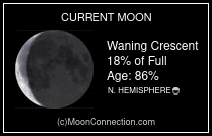
Saturday, August 16: The fat, waning crescent moon is four degrees from the Pleiades star cluster. Using binoculars, the pair should provide observers with a beautiful view of Luna and the best open cluster in the heavens. About seven degrees below the moon, approximately one binocular field, lies Uranus. The distances between the moon and the Pleiades, and between the Pleiades and Uranus, form an equilateral triangle, with the trio's wide base being the distance between the moon and Uranus. Binoculars will be required to see Uranus.
Sunday, August 17: Since yesterday, Luna has traveled nine degrees beyond the Pleiades, positioned above and to the moon's right. The Seven Sisters also lie five degrees from Uranus and the star 37 Tauri, forming an equilateral triangle. Uranus and 37 Tauri form the four-degree baseline with Uranus considerably fainter than 37 Tauri. Make this observation using binoculars unless you are Superman.
Monday, August 18: The 28 percent sunlit moon is located about 1.5 degrees (three lunar diameters) below +1.65 magnitude, Beta Tauri, the last star of upper (western) horn of the Bull. Beta Tauri is slightly brighter than the brightest star of the Big Dipper, and along with the moon, will create an enjoyable view through binoculars. If the sky is clear enough, earthshine, sunlight reflected from the Earth, then reflected back to us from the unlit parts of the moon, will appear as an ashen glow. Use binoculars to enhance the view. At 2 a.m., about 75 minutes after moonrise, Beta Tauri is a mere half degree from the limb (edge) of Luna.
Tuesday, August 19: The moon, which has now become a thin crescent, is present near several extremely bright objects closer to the horizon. Observe below and slightly to the right of Luna to view the mighty Zeus (Greek) or Jupiter (Roman). Still nearer to the horizon is the Greek goddess of beauty, Aphrodite, better known by her Roman name, Venus, the third brightest object in the heavens after the sun and the moon. To the left of Jupiter and Venus, you can see the luminaries of Castor (above) and Pollux, the heads of the winter star pattern of the Gemini Twins, rising on their sides, 20 and 16 degrees above the horizon, respectively.
Wednesday, August 20: This morning at 4:45 a.m., the waning crescent moon is ten percent sunlit. If conditions are clear enough, earthshine should be readily visible to observers with the unaided eye. Luna will be 16 degrees above the ENE horizon and only three degrees from Pollux. Castor will be above Pollux, Venus, to the right and below the moon, and Jupiter to the right and above Venus. Observers will not need binoculars to see this beautiful sight. Still, a wide field optical aid always helps by flooding the eye with more light, creating observations of greater transparency, as well as adding color to the view.
Thursday, August 21: By the start of nautical twilight, 5:15 a.m., the four percent razor-thin crescent moon is ten degrees above the horizon in the ENE, a difficult observation to make unless your horizon in that direction is nearly flawless.
Saturday, August 23: The moon is new today, shrouded in invisibility because of its proximity to the sun. On September 7, a total lunar eclipse is visible, centered over Asia, followed by a partial solar eclipse on September 21, visible over the southern Pacific and the portion of northern Antarctica facing South America.
Good viewing and clear skies to all. Maps are here. Ad Astra!
![[Star Map for Run with the Moon]](8-25-run-with-moon.png) |
|---|
| Observe at 4:45 a.m. to view the information presented on this map. An enlarged view of the first two days can be found below. Gary A. Becker graphics using Software Bisque's The Sky. |
![[Enlarged View for Run with the Moon]](8-25-run-with-moon-enlarged.png) |
|---|
| Observe at 4:45 a.m. to view the information presented on this map. Gary A. Becker graphics using Software Bisque's The Sky. |
AUGUST 24, 2025: A Message to My Students from the Ghost of AJ Minnich
I won't lie. I have been very stressed about PHYS 108 (astronomy)! In high school, I didn't have good experiences with math and science courses, and those occurrences have somewhat scared me away from taking any in college. I procrastinated about completing my lab science requirement for two years due to my past negative experiences. All summer I've been stressing out about this course, but doing this assignment has helped alleviate my worries. * I watched the interview with Stephen Colbert and Neil deGrasse Tyson, and it was an eye opener for me. I've been a big fan of Stephen Colbert for a long time because I really enjoy watching stand-up comedy and late-night talk shows. Colbert is among my favorites due to his smart and witty humor, as well as his thought-provoking messages. In this interview, he served as an excellent guide for me to dip my toes back into the world of science. His talking with Tyson felt like a collision of worlds that I initially thought were entirely separate. In my mind, I always thought that science was a whole lot of facts and memorizing, while stuff like English and political science were more about investigating different questions, concepts, and ideas. In retrospect, this belief was silly and woefully misinformed because it entirely wrote off schools of thought, despite them not being completely different from the ones I was already familiar with, even on a fundamental level. * I especially liked the part where Tyson tried to differentiate between someone who can memorize and someone who can adapt to new problems and questions and try to answer them. Intelligence isn't just a show of knowledge, but a skill that helps to solve problems and to interpret the world around you. After watching this, I also happened to talk with a friend who is a biology major. She said that she believes basic biology should be a requirement for all students because being equipped with knowledge and realizing how the body works can help people to understand their own bodies, and in turn, help others understand theirs as well. Having basic knowledge would, for example, help reduce the spread of vaccine misinformation because students would understand how vaccines actually work and be able to explain that information to others. Science "is a way of equipping yourself to interpret what happens in front of you," and that first requires you to inquire. * My previous train of thought was, as Tyson says, "lazy." I had past bad experiences in high school, so I stopped inquiring about a huge chunk of the world around me. Tyson states, "If you start wielding a hammer, then all of your problems look like nails," and that's precisely what happened to me. I was not equipping myself well enough to inquire about the world around me. Not every person should be a science major or an English major. Still, everyone should at least have the tools necessary to understand what is in front of them, even on a basic level. * Knowledge, no matter which form it takes, is a vanguard to protect you from the "charlatans of the world." Knowledge is something that can prevent you from falling for snake oil merchants, false prophets, Fox News, and more. That is why literacy across a variety of different fields is essential. Additionally, all the various academic fields interact with each other more than many people think or expect. * For example, I am the editor of the school newspaper, but even though our staff is composed mainly of English and communications majors, we all need to have a somewhat diverse set of knowledge skills to do our jobs. To inform and to engage our readers, we all need to understand a variety of topics. Watching this interview made me realize that I was seeing all of my problems as nails, and it was high time that I needed to shake things up. Ad Astra!
AUGUST 31, 2025: Carlson's First Uranian Birthday
![[Uranus Cartoon, Mark Parisi]](8-25-uranus-cartoon.jpg) |
|---|
Here is the tamest Uranus joke that I could find on a 2023 post devoted to laughs about the seventh planet. I thought it odd that the page had 85,591 views with zero comments at the time that I accessed it.
Patient: "Doctor, am I going to be alright?"
Doctor: "I'm not too sure, Mercury is in Uranus now."
Patient: "But I don't know much about astronomy and space."
Doctor: "Neither do I, but I do know that my thermometer just snapped inside of you."
Then, and this is real in 2025, there are Dude Wipes: "See how wet Dude Wipes completely clears while dry teepee [toilet paper] smears, leaving debris on Uranus." Visit the YouTube video for the full experience, if you dare. * The commercial uses the alternate, less humorous form of pronouncing the planet, "your an us," but does spell the word Uranus in the ad. In grade school, I was taught the original version that usually produces laughter, "your anus."
Achieving your first Uranian birthday, however, is no laughing matter, and for an astronomer, it is an achievement that calls for celebration. My good friend and former astronomy professor at Kutztown University, Dr. Carlson R. Chambliss, benefactor to Moravian University's astronomy program and founder of Moravian's Chambliss Award, just achieved his first birthday on Planet Seven at the age of 84. If you would like to know your age on the eight planets in our solar system, including Pluto, you can go to San Francisco's Exploratorium, here. Carlson turned one on Uranus this past July 22, just a few days after his 84th terrestrial birthday, which he celebrated on July 17. Former colleagues, students, and friends attended Carlson's first Uranian birthday celebration on August 9. There were balloons, gifts (don't ask me to describe them), toasts to the Uranian youngster, and of course, a cake, you guessed it, in the shape and the blue-green hues of the methane, gas giant planet. I think I have said enough.
Congratulations, Carlson! Many more terrestrial birthdays are hopefully in your future. Ad Astra!
![[Carlson's First Uranian Birthday]](8-25-carlsons-first-uranian-birthday.jpg) |
|---|
| Dr. Carlson R. Chambliss' first Uranian Birthday Party held on August 9 in Douglassville, PA: Celebrants from left to right are Peter K. Detterline, Kitty Greer, Gary A. Becker, Carlson R. Chambliss, John and Janice Loomis, Valerie Reidout (inset), and Phill Reed. Not included in the image are Ken Reidout, Nancy Reed, and Susan B. Reisinger-Becker. Photography by Valerie Reidout; graphics, Peter K. Detterline... |
![[August Star Map]](8-25-stars.png) |
![[August Moon Phase Calendar]](8-25-moon.jpg) |