StarWatch for the greater Lehigh Valley
---------------

JUNE  2026

JUNE STAR MAP | MOON PHASE CALENDAR | STARWATCH INDEX

[Moon Phases]

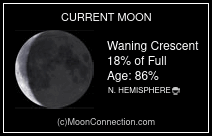
CURRENT MOON PHASE

---------------
1555    JUNE 7, 2026:   Sundown Planet Gathering
If you have had an eye on the western sky during the last several weeks, you may have noticed Venus and Jupiter getting chummy. Just three weeks ago on May 18, the thin waxing crescent moon was next to Venus during twilight. The following evening, Luna was approaching Jupiter and moving away from Jove on the 20th. * On June 7, Jupiter, the fourth brightest object in the heavens, is paired with Venus, the third brightest body in the sky. It is impossible to miss the two planets located in the WNW shortly after sundown. Their spacing will be only 2.3 degrees distant, 45 minutes after sundown. They will set by 11 p.m. * This would be a great opportunity to test your visual acuity by finding Venus in the daytime sky. I've done it at least a half dozen times. Start by using binoculars to locate the Goddess of Beauty when Sol is close to setting but still has not set. Don't look at the sun. Venus will be positioned 36 degrees to the left and above the sun, about four fists at arm's length held next to each other. Then view with binoculars in that direction, making slow circular sweeps to look for a bright point of light against the darkening blue sky. That will be Venus. When found, remove your binoculars and view in the same area to find Venus with the unaided eye. Using binoculars first will help you to know precisely where to look. It's not easy, but if successful, you'll be able to boast that you've seen the Goddess of Beauty with the unaided eye in broad daylight. * Fifteen minutes after sundown, Venus' visibility should be a no brainer, and Jupiter should become visible with the unaided eye about 15 minutes after that. I once caught Venus multiple times during the afternoon on an incredibly clear summer day. The sun was hidden behind my parents' house, the sky a rich, deep Santa Fe blue. Standing in the shade with the sun's glare suppressed, I made the observation at least three times, my criterion for confirming that a sighting is real. However, there is more. * Lurking near the horizon on June 7 will be the smallest planet in our solar system, Mercury. The Messenger God's location will be to the right of and below Jupiter and Venus, nearly ten degrees above the WNW horizon, 45 minutes after sunset. Binoculars will easily reveal Mercury 30 minutes after sundown when it is a little higher in the sky. If it is clear enough, no optical aid will be necessary. * As the week progresses, Mercury and Venus will continue to climb higher into the dimming evening sky while Jupiter will appear to be drawn toward the sun. By June 16, Venus, Jupiter, and Mercury will be equally spaced in the darkening twilight sky, but a new player, a thin waxing crescent moon filled with plenty of earthshine, will be located between Jupiter and Mercury. The moon and Venus will be paired in a similar fashion to the previous month on June 17. Only this time, Luna will be to Venus' left. "Have fun," as my friend, Terry Pundiak, tells me nearly every time we communicate. To all, be friends with the night. Ad Astra!
 

1556    JUNE 14, 2026:   Hail Mary: The Martian on Steroids
I cannot believe it has been more than 11 years since I was a participant in the Mars Society convention hosted by the University of California, Irvine. The culminating banquet event was an interview with (fear-of-flying) Andy Weir, author of The Martian (2011), and more recently, Artemis (2017), and Project Hail Mary (2021). When Weir came on the Zoom screen, he had a sheepish grin on his face. When asked how he was doing, Weir revealed that royalty checks for his book and his upcoming feature film, The Martian, had just been received within the past few days. His exact words were, "It's been a really good week." * What made The Martian such a great reading experience was its detail to scientific accuracy which Weir culled after first self-publishing chapters on Amazon that were feverishly read by an audience of approximately 5000 participants, some who were well-versed in the scientific community. Readers corrected mistakes along the way to a very receptive Weir. * Much less so with Project Hail Mary, where Weir writes of contact with a member of a planet in the Eridani star system. He is so far off the charts in terms of known human biology that at first it stretches credibility. The protagonist, Dr. Ryland Grace, is a reluctant astronaut, molecular biologist, and middle school teacher who has been forced to journey to Tau Ceti, 12 light years distant from Earth to solve the problem of why the sun is dying. He meets Rocky, who is there for the same reason, but from Erid, a super-Earth in the 40 Eridani A star system. It is 16 light years from Earth. * Rocky lives under a thick, hot, ammonia-based atmosphere. He has a rock-like carapace, no face, is blind, navigates via echolocation, communicates via musical notes, possesses a photographic memory via a computer-like crystalline brain, and has five hearts that pump mercury-based blood throughout his five-armed body. * There is not a lot to love in Rocky's description, but that is where Andy Weir's imagination shines the brightest. Rather than slugging it out, Grace and Rocky get along. They learn to communicate, rapidly discovering that each individual's weaknesses are the other's strengths, enhancing the probability of their missions' success. * Both are the last survivors of deep space Hail Mary probes to save their home worlds. Astrophage microbes are depleting their suns' energy as well as all stars in the local stellar neighborhood except for one luminary, 12 light year distant, Tau Ceti, where energy output remains unchanged. In Earth's case, Astrophages race from the sun to Venus' rich carbon dioxide atmosphere, where they reproduce and head back to the sun to gain more energy to repeat the cycle over again. The same situation is occurring on 40 Eridani, where its third planet, Adrian, has a CO2-rich atmosphere. What makes Tau Ceti different is the discovery by Grace and Rocky of another microbe, Taumoebas, that can eat the Astrophage, that interrupt the cycle. The goal is to return Taumoebas to their CO2-rich planets in their home systems before the cosmic winter sets in and causes their respective species to go extinct. * Despite the hardships, Rocky and Grace manage to navigate the unlikely connectivity of their species. They develop a bond and a friendship as strong as the xenonite material that Rocky's species has developed to build virtually everything on his home world, including his spacecraft. When the problem of taming Astrophages is completed, their only recourse is to return to save their home worlds. At this juncture, the reader has also bonded with the characters and feels a genuine loss for the camaraderie that both Grace and Rocky have developed. However, that is not the conclusion of the sci-fi space thriller. * Project Hail Mary is a roller coaster ride of endurance, successes, failures, and learning to trust in an alien landscape that has a surprise ending that I will not divulge. Read the book and get beyond the first chapter which was confusing to me and almost made it a nonstarter. It did for my wife who unbeknownst to me, had purchased a hardbound copy of the book. I paid $22 for my paperback edition at Barnes and Noble. Ad Astra!
 

1557    JUNE 21, 2026:   Summer Solstice at Chaco Canyon
It has been over a quarter century since I spent four consecutive summers (1998-2001) volunteering for the National Park Service, some of them with students, as a Night Sky Interpreter at Chaco Culture National Historical Park, a UNESCO World Heritage Site in NW New Mexico. There I was given the opportunity to photograph the park, work with the visiting public during daytime solar watches and nighttime observing, and research an archeological site above the campgrounds. "Poetically" named 29 SJ 532, it consisted of a huge overhanging slab bisected by a naturally created crack in the rock. Beneath the precipitous overhang was a large, flat, rock face tilted toward the south, with several petroglyphs (chiseled rock art), a spiral near the top of the panel, an antlike insect below, bird tracks, and Maya-looking numbers that to this day have no explanation. About 35 yards to the east southeast was a small mesa overhang and a large, flat section of shaded, cooler rock, where I found two butt indentations that had been ground into the yellowish sandstone by some ancient sky watcher, perhaps as much as a 1000 plus years ago. A shaded astronomer priest could comfortably watch while seated, as I did, the progression of a small dagger of sunlight descend down the rock's face near noon, perfectly bisecting the spiral about 10 or 11 days before the summer solstice, the highest southerly position of the sun for the year and also the longest day. * A predictive solstitial marker was the conclusion reached by the National Park Service. This period before the day of summer solstice was a sufficient amount of time to prepare for the religious ceremonies associated with the time of the highest sun. This would have included preparing the food and practicing the dances for the thousands of participants who would descend into the canyon along a spider web of roads, representatives of the hundreds of outlying towns associated with the canyon. While I was there, I had the privilege of seeing the first Native American dances performed on the plaza of Pueblo Bonito (beautiful town) in over 800 years. * Some archaeoastronomers believe that on the morning of the summer solstice, participants gathered at Casa Rinconada (and other Great Kivas), a circular, dark, underground roofed ceremonial chamber, that could hold as many as 400 worshippers. Deep-throated vibrations created by dancers pounding a synchronized rhythm on foot drums called the faithful to worship before dawn. Smoke from a central charcoal fire wafted slowly upwards through a hole in the massive timber ceiling as silent observers waited in Rinconada's interior for the sun to rise over North Mesa. Suddenly, a burst of yellowed light crossed the breadth of the dusty canyon floor. Passing through the only window at Casa Rinconada, it swept across the kiva to splash a narrow rectangle of itself on the opposite wall. As the sun inched higher into the desert morning, the swatch of brightness moved slowly down the wall and settled into a niche. The day of the summer solstice had finally arrived. Today Rinconada is a roofless, stabilized ruin, but the sun keeps it yearly appointment with the niche as it did 1000 years ago. * At a time when the sun and the moon were considered gods, it was important to track their motions, to say the prayers, and to perform the rituals to prove to these deities that The People were obedient and thankful, of good heart, and followed the rules of a productive life. * Summer solstice is just another day for most of us, a little more special if you are an astronomy enthusiast, but to the ancient cultures of the Southwest, it was considered a matter of life and death, a means of creating a calendar, and a way of establishing order in a chaotic world. Happy summer solstice, Sunday, June 21, 2026, at 4:23 a.m., EDT to everyone, but mainly to the Chacoan souls of the departed. Images of 29 SJ 532, which I named the Mini-Sun Dagger, and Casa Rinconada on the morning of summer solstice are found below. Ad Astra!

[Mini Sun Dagger]
The Mini Sun Dagger (above). Fran Kittek photo...

[Summer Solstice, Casa Rinconada]
At Casa Rinconada in Chaco Culture National Historical Park, the sun works its way down a wall to settle into a niche on the day of the summer solstice. Fran Kittek photo...
 

1558    JUNE 28, 2026:   Neil Armstrong: A Life of Flight
Many years ago, when I was director of the Allentown School District Planetarium, now the Learning Dome, I bonded with Rosa Salter, the Morning Call's science correspondent. She was an award-winning, almost poetic writer who was also very interested in astronomy. As our association grew from a professional relationship to one of friendship, Rosa would allow me to read her copy for any factual mistakes. I promised never to challenge her writing style and to counsel her only on content. She made very few errors. The result was the creation of dozens of wonderful articles that hyped the beauty and science of astronomy, including a friendship that continues to this day. * Likewise, the late Jay Barbree (1933-2021), NBC News Space Correspondent for 56 years, bonded with Neil Armstrong, each one over the devastating loss of a young child from their respective families. The communication and respect that grew over decades of friendship allowed Barbree to produce an intimate portrait of Neil Armstrong: A Life of Flight. St. Martin's Press, 2014. * So who was Armstrong? A kid trying desperately to soar like the birds, Korean War aviator who got shot down after strafing a bridge, Purdue University graduate, X-15 pilot, commander of Gemini 8 and Apollo 11, first human on the moon… Any one of these accomplishments would have been enough to create a sense of satisfaction for a life well-lived, but to be successful at all of them could have created an individual with an egocentric personality and a loss of compassion for the average person. That was not Neil Armstrong. In a true sense, Armstrong followed the Scout Credo, doing his best for God and country, helping others at all times, and keeping himself physically strong, mentally awake, and morally straight. * Armstrong shied away from the limelight; he spoke quietly without much emotion as I heard him from a seat immediately in front of his lectern in a talk that he give on an eclipse cruise during the summer of 1973. He departed the room immediately afterward, taking no questions, leaving the audience before they could exit. When the moderator's remarks were concluded, I bolted for the door and down one of four corridors that confronted me. Fortuitously, I picked the right path, and for a New York minute, it was just Neil Armstrong and me, face-to-face. I cannot say that our conversation was profound in any way, but he acted like the Neil in Barbree's book: attentive, gracious, pausing for a moment to reflect about my query, and then quietly responding. Of course, then came the autographs, one for my girlfriend at the time and one for me. As insignificant as it must have been to Armstrong, it was a moment etched into my soul, a one-on-one moment with the Columbus of the space age. * Jay Barbree's 362-page work does not give the reader a blow-by-blow accounting of every aspect of Armstrong's life or for that matter the history of spaceflight, but rather a detailed perspective of the events that shaped his life in specifics that only a conversation with a good friend could reveal. It is the best accounting of Armstrong that I have read to date, accrued from primary source material, the personal recollections of the first human to set foot on another world. It is a book worth reading as we near the 57th anniversary of Apollo 11. Ad Astra!
 

[June Star Map]

[June Moon Phase Calendar]
 

---------------