![[Moon Phases]](../moonphases/2026-10-phases.jpg) |
|---|
 |
 |

 OCTOBER 4, 2026: Early Bird StarWatch
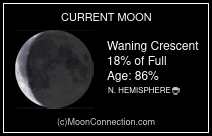
Sunday, October 4, 4-6 a.m.: Moon near Gemini Twins, Castor and Pollux. Normally, Luna's luminescence would wash away even the brightest stars of the Gemini Twins, Castor and Pollux, when nearby, but this morning the waning crescent is only 1/13th its full-moon brightness, allowing both stars to be observed easily with the unaided eye. As in all cases, binoculars will enhance your views because they collect dozens of times more light than the human eye. Look for the moon high in the southeast.
Monday, October 5, dawn: Mars and the moon. This morning a thinner, less bright waning crescent moon, 23 times fainter than its full moon counterpart, confronts the god of war, Mars, at a distance of only three degrees in the eastern sky. Less than one degree below the moon is M44, an old but bright open cluster also known as the Beehive, containing about 1,000 gravitationally bound stars. About 40 or 50 luminaries are visible using binoculars. From rural locales, this cluster is easily visible to the unaided eye, but not from suburbia. Mars is close by and rendezvous with the Beehive next week.
Tuesday, October 6, dawn: Moon and Jupiter snuggle. I may even stay up for this one. The thinning, waning crescent moon is just over 1/50th as bright as the full moon. Jupiter is positioned just over half a degree from the moon's eastern limb. Look toward the east, slightly under mid-sky, for this beautiful sight, which will dazzle the eye and look even better in binoculars. Try an image with your smartphone, especially as the sky begins to brighten with a rosy red glow.
Wednesday, October 7, dawn: Moon near Regulus. Leo the Lion hosts a skeletal, crescent moon low in the east as it departs from the brightest star of the Lion, Regulus, located above the moon. Look for earthshine, the reflected light coming from a nearly full Earth illuminating the unlit portions of the moon. Observing the moon with binoculars will make seeing earthshine a no brainer.
All the best for your successful observations of these celestial events this week. I'll most likely still be in bed. Ad Astra!
OCTOBER 11, 2026: Mars Disturbs the Beehive this Week
![[Mars Disturbs the Beehive]](10-26-mars-disturbs-beehive.png) |
|---|
| This maps shows the lineup of bright stars and planets which should prove helpful in locating Mars and the Beehive cluster. Binoculars or a small telescope will be necessary to observe the event. Map generated through Software Bisque's The Sky; inset photo of the Beehive, Gary A. Becker... |
OCTOBER 18, 2026: Good Year for the Orionids
![[Orionid Meteor Shower Radiant]](10-26-orionid-meteors.png) |
|---|
| Meteors from the Orionid Shower will appear to fan away from the radiant, the red dot near the elbow of Orion the Hunter. Map created by Gary A. Becker from Software Bisque's The Sky... |
OCTOBER 25, 2026: Moon Transits Pleiades
![[October Star Map]](10-26-stars.png) |
![[October Moon Phase Calendar]](10-26-moon.png) |